Melify.

Discover, rate, and review music

AboutBlogsTop 100 SongsSongs AI Can't MakePrivacyTermsSupportContactFeedback

© 2026 Melify

We do not sell personal information. See Privacy for details.

Melify.
A Melify series

Songs AI can't make.

A running list of songs written by grief, exile, dictatorships, and love — things a prompt can't feel.

One song per language, told through the people who lived with it — real fan voices in the original language, translated to English. Tap any song title or artist to open it on Melify and add your own rating. New entries added as the series continues.

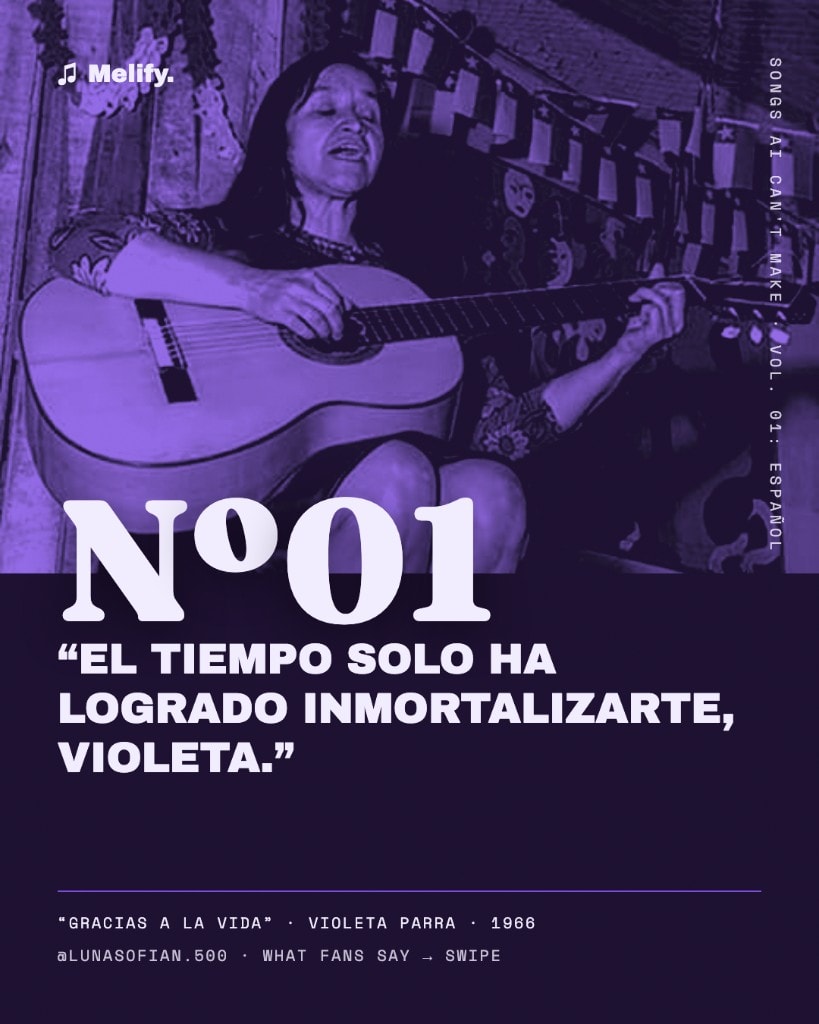
Songs AI Can't Make Nº1 — Gracias a la Vida by Violeta Parra
SpanishChile, 1966Las Últimas Composiciones

“Gracias a la Vida”

Violeta Parra

Violeta Parra spent her life collecting Chile's folk songs village by village, then wrote the most famous one herself. “Gracias a la Vida” — “Thanks to Life” — is a hymn of gratitude: for eyes, for sound, for the alphabet, for the beloved's footsteps.

She wrote it while heartbroken, a year before she took her own life. That is the entire song: someone thanking life while it is breaking them. It became Latin America's unofficial anthem, sung at funerals, protests, and weddings alike. A model can imitate the melody in seconds. It cannot mean it.

About the song
Written by
Violeta Parra
Released
November 1966
Album
Las Últimas Composiciones
Language
Spanish
Movement
Nueva Canción Chilena
Famously covered by
Mercedes Sosa, Joan Baez

“Gracias a la Vida” (“Thanks to Life”) was written and composed by the Chilean folk singer-songwriter Violeta Parra in La Paz, Bolivia, in 1966. It opens Las Últimas Composiciones, the final album she released before her death in February 1967. The lyrics enumerate the gifts of being alive — sight, hearing, language, the beloved’s footsteps, even laughter and tears — framing them as reasons for gratitude despite suffering.

A cornerstone of the Nueva Canción Chilena movement, it became one of the most covered Latin American songs in history — carried worldwide by Mercedes Sosa (1971) and Joan Baez (1974), and later by artists from Yo-Yo Ma and Plácido Domingo to Kacey Musgraves. It was inducted into the Latin Grammy Hall of Fame in 2013.

SourcesWikipedia: Gracias a la vidaWikipedia: Las últimas composiciones
What fans say
Muchos dicen: “Si Violeta amaba tanto la vida, ¿por qué se terminó suicidando?”… Que se haya quitado la vida no le hace menos grande ni le quita sentido a su obra maestra… Personas reales, intensas como Violeta hacen falta hoy en día. El tiempo solo ha logrado inmortalizarte, Violeta. ¡¡¡Gracias Violeta!!!
Many ask: “If Violeta loved life so much, why did she end her own?”… Taking her life doesn’t make her any less great, nor does it strip meaning from her masterpiece… The world needs real, intense people like Violeta today. Time has only made you immortal, Violeta. Thank you, Violeta!!!
@lunasofian.500 · YouTube · 7.5K likes
Es mi himno y no logró imaginar a cuantos millones de seres humanos les pasa igual que a mi.
It’s my anthem, and I can’t even imagine how many millions of human beings feel exactly the same way I do.
@mariamercedescastanoramos9637 · YouTube
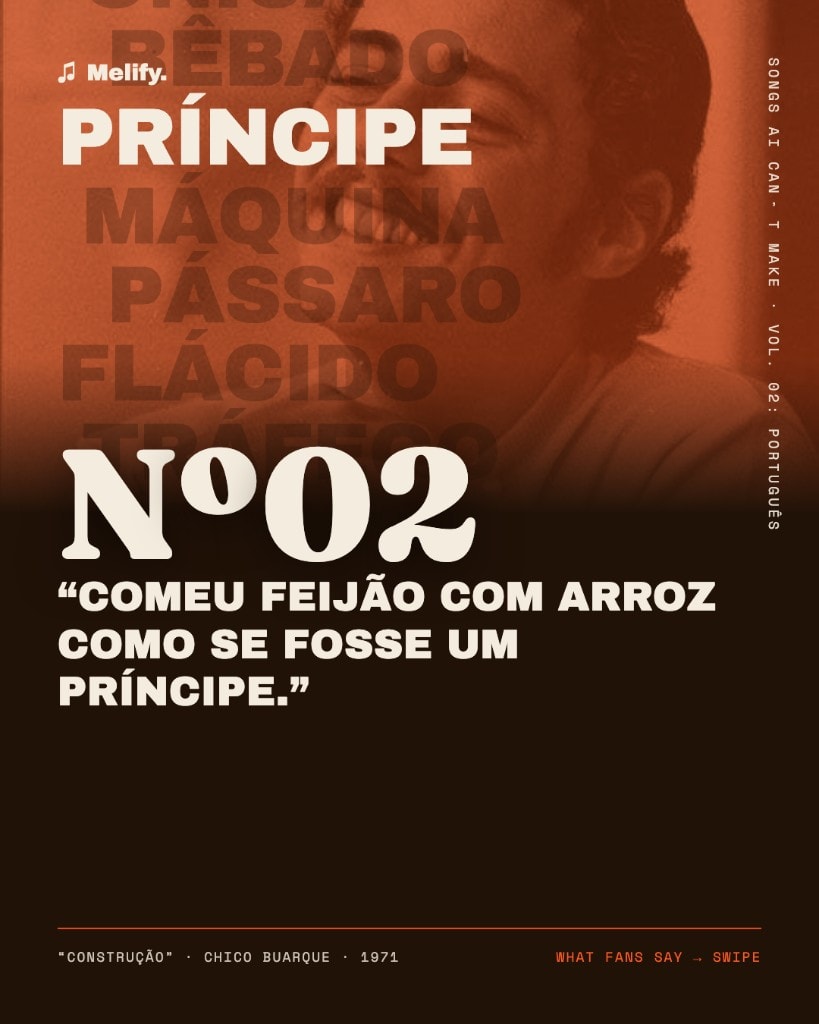
Songs AI Can't Make Nº2 — Construção by Chico Buarque
PortugueseBrazil, 1971

“Construção”

Chico Buarque

Chico Buarque wrote “Construção” in 1971, at the height of Brazil’s military dictatorship. It follows a construction worker through his last ordinary day — kissing his wife, climbing the scaffolding, eating his lunch — until he slips, falls, and dies in the street “disrupting the traffic.”

Every line ends on a proparoxytone — a word stressed on the third-to-last syllable — and the verses are rebuilt from the same words in a new order each time, so the lyric is literally constructed like the thing it describes. It is a masterpiece of Portuguese engineering and a protest smuggled past the censors. A model can rhyme proparoxytones on command. It cannot grieve an anonymous man a regime tried to erase.

About the song
Written by
Chico Buarque
Released
1971
Album
Construção
Language
Portuguese
Arrangement
Rogério Duprat
Honors
Greatest Brazilian song (Rolling Stone, 2009)

“Construção” is the title track of Chico Buarque’s eighth album, recorded for Philips Records in 1971 after his return from self-imposed exile in Italy during Brazil’s military dictatorship. Narrated in impersonal third person, it recounts the last day of a construction worker whose death is treated as a disruption to traffic rather than a human tragedy — a veiled critique of labor and social alienation under the regime.

The song is built on a strict structure: 41 dodecasyllabic lines that each end in a proparoxytone, reassembled from the same words in shifting order across three sections. The orchestral arrangement is by Rogério Duprat, a key figure of Tropicália. Rolling Stone Brasil named it the greatest Brazilian song of all time in 2009, and it featured at the 2016 Rio Olympics opening ceremony.

SourcesWikipedia: Construção (song)uDiscover Music feature
What fans say
Não dá para explicar um “Comeu feijão com arroz como se fosse um príncipe” para ninguém fora do Brasil não. Forte demais.
There’s no way to explain “he ate rice and beans as if he were a prince” to anyone outside Brazil. Too powerful.
@rodrigopassos9815 · YouTube · 3.3K likes
O texto inteiro é uma crítica à vida vazia de um trabalhador, um “zé ninguém” que ninguém se lembra. Chico mostra como uma vida pode ser, ao mesmo tempo, tão importante e tão insignificante.
The whole song is a critique of the empty life of a worker — a “nobody” no one remembers. Chico shows how a life can be, at once, so important and so insignificant.
@rodrigocampos9283 · YouTube · 821 likes
Sou brasileiro e por 25 anos ignorei a música popular brasileira… Aí ouvi este disco e ele tomou meu mundo de assalto. Se você não fala português, precisa aprender. Sim, este disco é tão bom assim.
I’m Brazilian, and for 25 years I ignored Brazilian music… Then I heard this album and it took my world by assault. If you don’t speak Portuguese, you must learn. Yes, this album is this good.
@juliano_q · RateYourMusic
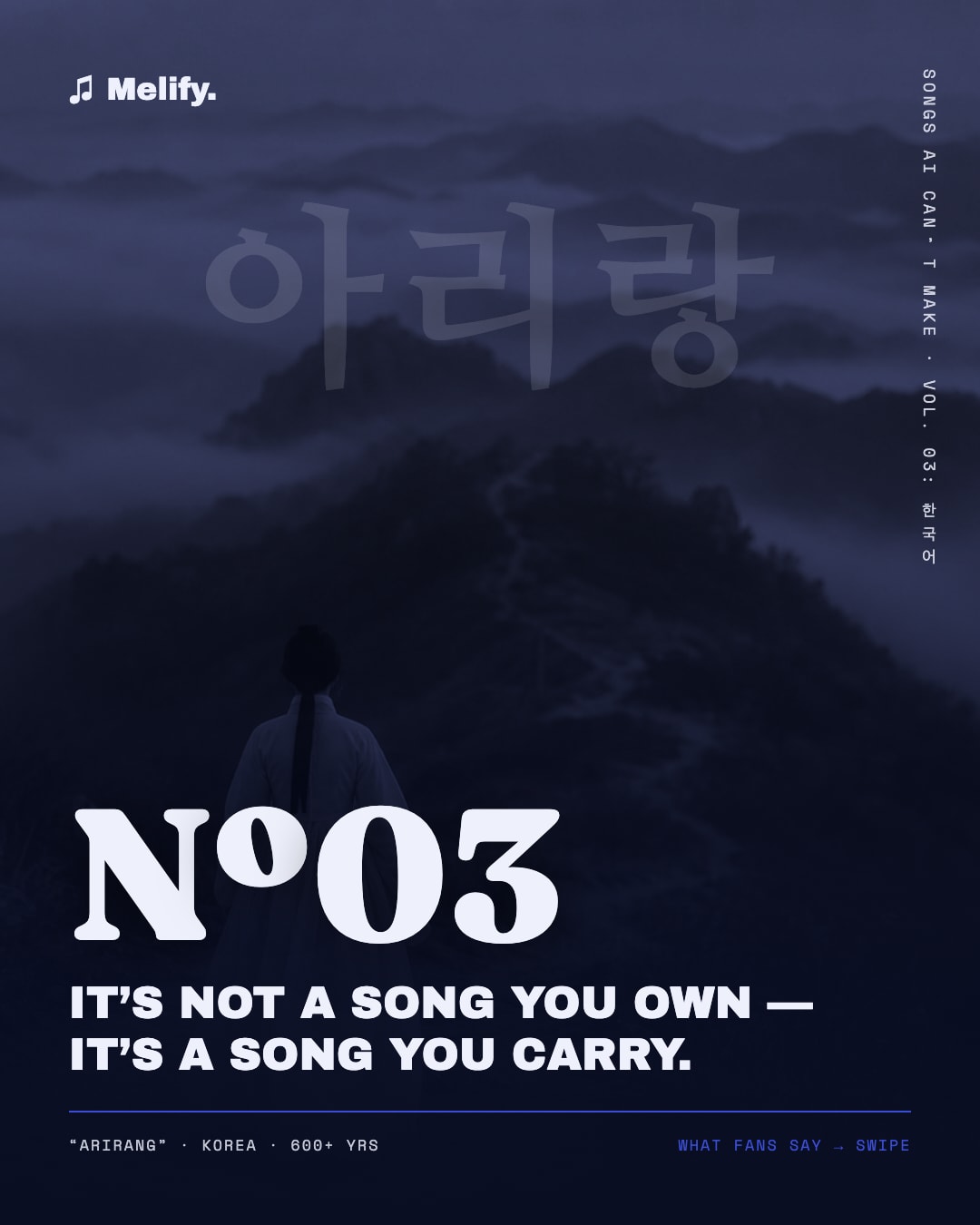
Songs AI Can't Make Nº3 — Arirang, the Korean folk song
KoreanKorea, trad.

“Arirang”

Traditional · 600+ years old

Nobody wrote “Arirang.” It is more than 600 years old, has no composer, and exists in some 3,600 regional variations — it was worn smooth by millions of ordinary Koreans across centuries until it became the country’s unofficial anthem. The word itself means nothing; the ache underneath does. Every version is about someone going over a mountain pass, leaving — maybe never to return.

It carries 한 (han) — a word with no English equivalent: sorrow, longing, and endurance in a single breath. Koreans sang it as resistance under Japanese occupation, as comfort through war, and as the song for families split by a border they never chose. A model can generate a folk melody in seconds. It cannot be authored by a whole people over six centuries, and it cannot inherit their grief.

About the song
Origin
Korea · traditional
Age
Est. 600+ years
Variations
~3,600 across 60 versions
Refrain
“Arirang, arirang, arariyo”
UNESCO
Intangible Cultural Heritage (2012 / 2014)
Also known as
Korea’s unofficial anthem

“Arirang” is Korea’s most beloved folk song. It has no single author and exists in an estimated 3,600 variations across some 60 regional versions — among them Jeongseon, Jindo and Miryang Arirang — all sharing the refrain “Arirang, arirang, arariyo.” Believed to be more than 600 years old, it is often called Korea’s unofficial national anthem because nearly every Korean, at home or abroad, can sing at least part of it.

During the Japanese occupation (1910–1945) it became an unofficial resistance anthem, sung during the 1919 March First Movement; several wartime variants were later banned for “disturbance of public order.” UNESCO inscribed “Arirang” on the Representative List of the Intangible Cultural Heritage of Humanity — submitted by South Korea in 2012 and by North Korea in 2014.

SourcesWikipedia: ArirangUNESCO ICH: Arirang
What fans say
It just touches our soul. It’s very sorrowful, and it feels like pain.
Won Hyung-joon · PRX · The World
Half of them couldn’t understand the words. They were crying anyway. You can’t teach that — and they’ll never forget it.
Younghae Kim · Inheritance
My grandfather was sent to fight and never returned. We had no bodies to bury, and it killed my parents’ souls. When I hear Arirang, I think of him.
a grandson · via Jae-Ha Kim
It’s not a word but a war.
E.J. Koh · “American Han”

Coming up in the series

5 more languages, 5 more songs no model could write. Follow @melify.app to catch each drop.

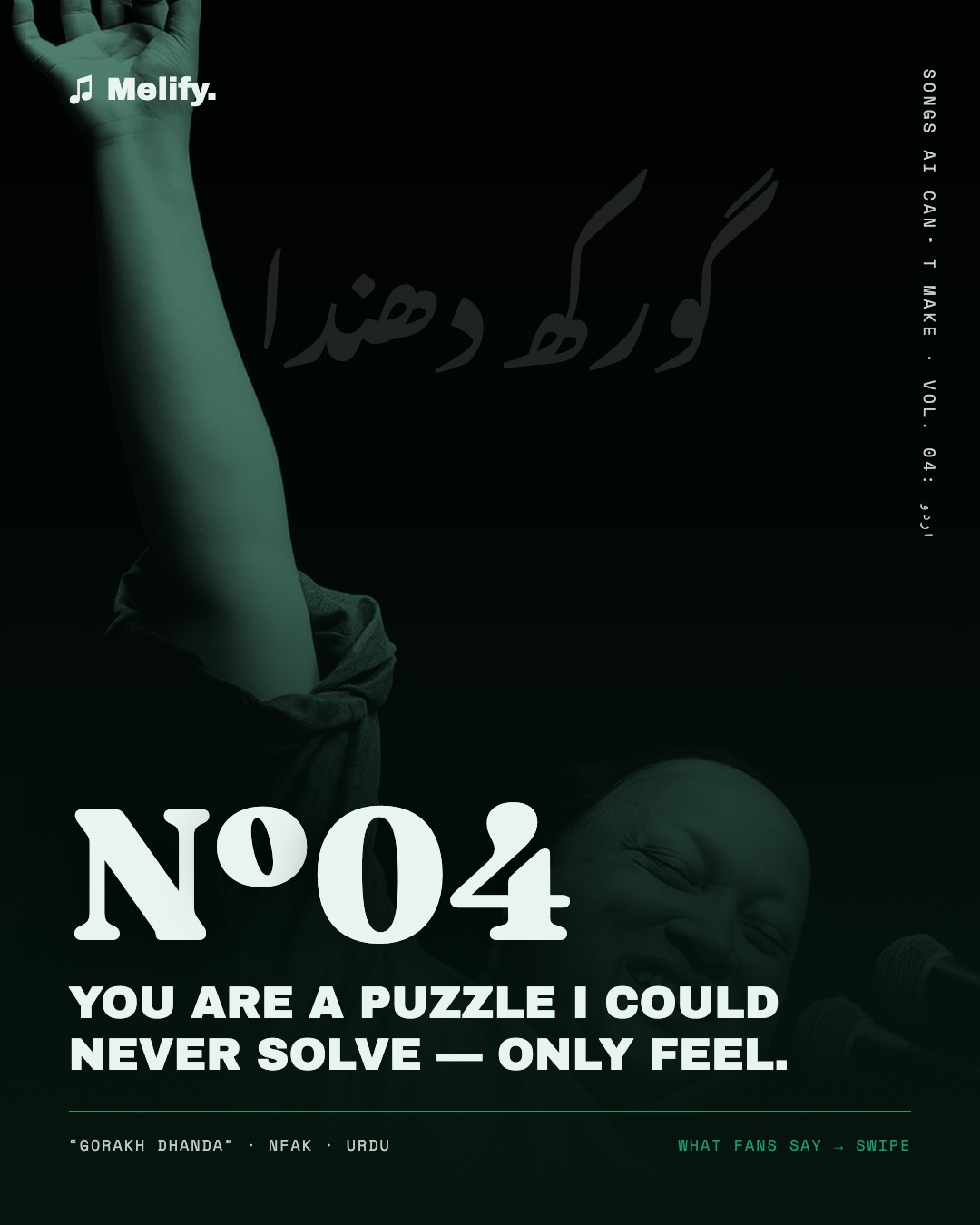
Nº 04
Hindi
Revealing soon
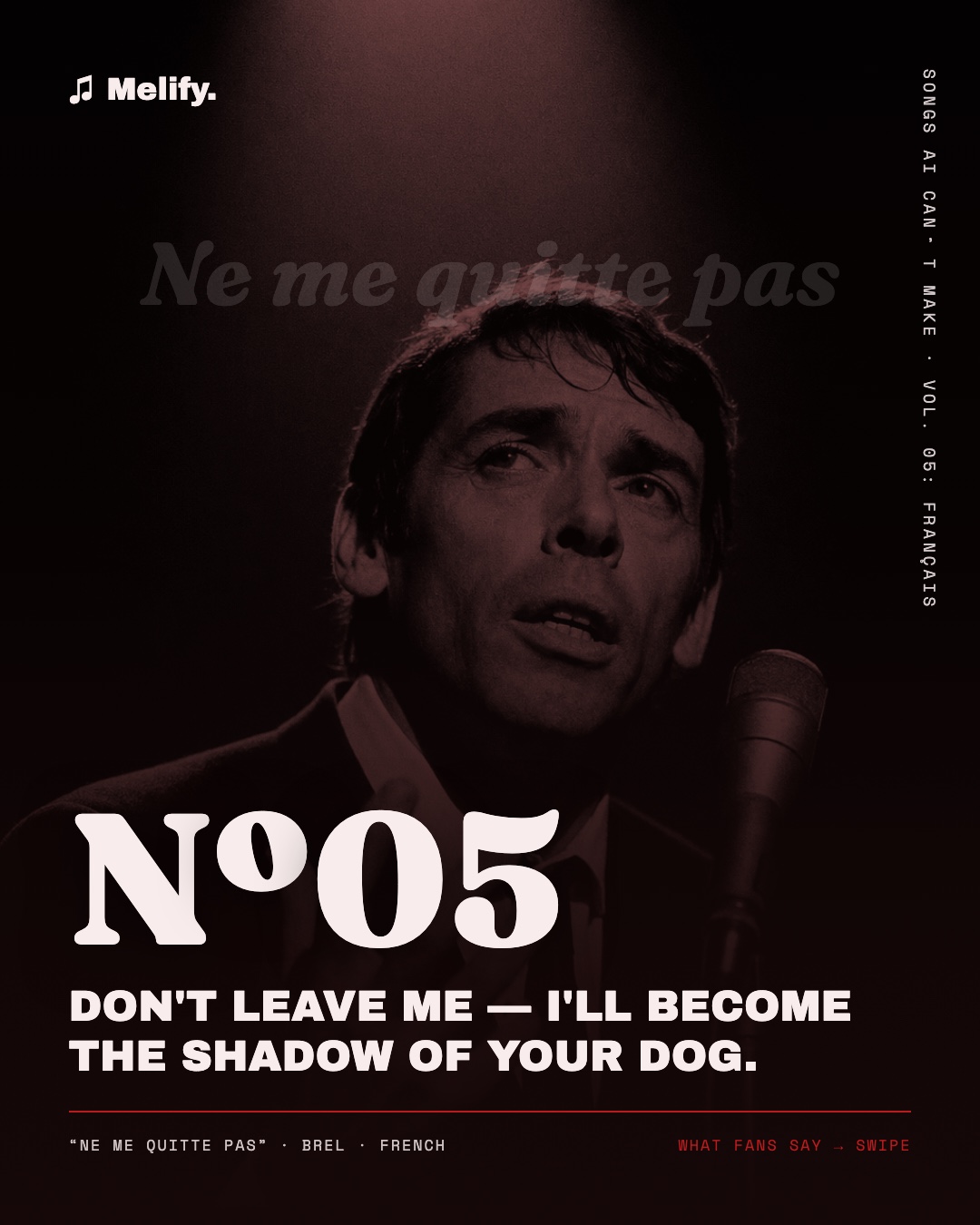
Nº 05
French
Revealing soon
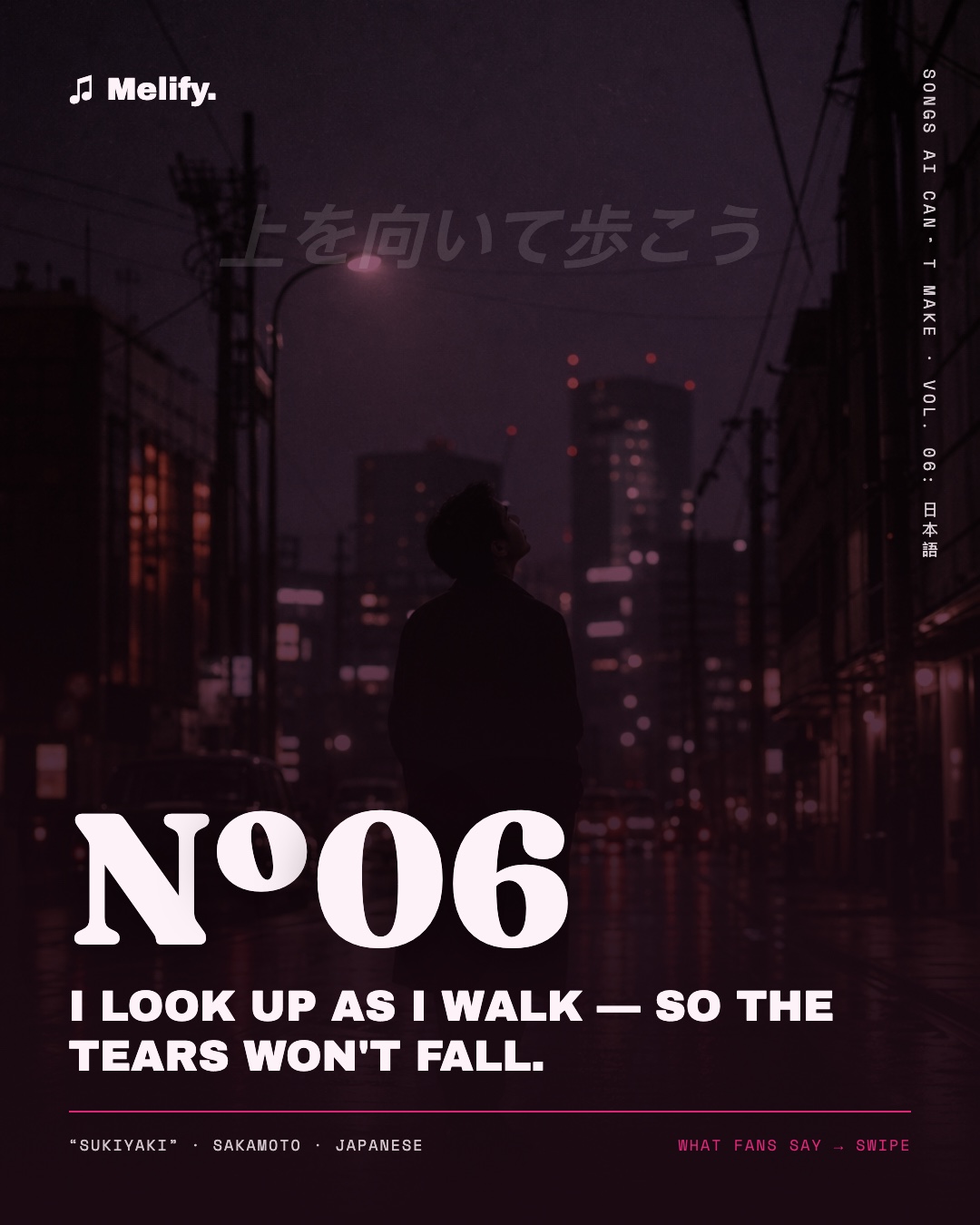
Nº 06
Japanese
Revealing soon
Nº 07
Arabic
Revealing soon
Nº 08
Urdu
Revealing soon

Every song here can be rated and reviewed on Melify.

Add your own voice — in any language. That's the part AI really can't do.

Find musicTop 100 songs
TRENDINGGut Genug (mit Blumengarten & Shirin David) by KITSCHKRIEG, Blumengarten, Shirin David/TRENDINGDon't tell your dreams by LOVIXX, STOSLIV/TRENDINGMovin' To The Sun by HUGEL, Imael Angel, Ultra Naté/TRENDINGBeni Al Ta ki Seni Görene Kadar by Sincesh M/TRENDINGDai Dai by Shakira, Burna Boy/TRENDINGJamaican (Bam Bam) by HUGEL & SOLTO (FR)/TRENDINGSelf Aware by Temper City/TRENDINGDancing On My Own by Robyn/SEARCHEDhanuman/SEARCHEDcharl/SEARCHEDtaylor/SEARCHEDcentral/SPOTIFYSave My Love by Kygo, Khalid, Gryffin/SPOTIFYFortnight (feat. Post Malone) by Taylor Swift, Post Malone/TRENDINGGut Genug (mit Blumengarten & Shirin David) by KITSCHKRIEG, Blumengarten, Shirin David/TRENDINGDon't tell your dreams by LOVIXX, STOSLIV/TRENDINGMovin' To The Sun by HUGEL, Imael Angel, Ultra Naté/TRENDINGBeni Al Ta ki Seni Görene Kadar by Sincesh M/TRENDINGDai Dai by Shakira, Burna Boy/TRENDINGJamaican (Bam Bam) by HUGEL & SOLTO (FR)/TRENDINGSelf Aware by Temper City/TRENDINGDancing On My Own by Robyn/SEARCHEDhanuman/SEARCHEDcharl/SEARCHEDtaylor/SEARCHEDcentral/SPOTIFYSave My Love by Kygo, Khalid, Gryffin/SPOTIFYFortnight (feat. Post Malone) by Taylor Swift, Post Malone/TRENDINGGut Genug (mit Blumengarten & Shirin David) by KITSCHKRIEG, Blumengarten, Shirin David/TRENDINGDon't tell your dreams by LOVIXX, STOSLIV/TRENDINGMovin' To The Sun by HUGEL, Imael Angel, Ultra Naté/TRENDINGBeni Al Ta ki Seni Görene Kadar by Sincesh M/TRENDINGDai Dai by Shakira, Burna Boy/TRENDINGJamaican (Bam Bam) by HUGEL & SOLTO (FR)/TRENDINGSelf Aware by Temper City/TRENDINGDancing On My Own by Robyn/SEARCHEDhanuman/SEARCHEDcharl/SEARCHEDtaylor/SEARCHEDcentral/SPOTIFYSave My Love by Kygo, Khalid, Gryffin/SPOTIFYFortnight (feat. Post Malone) by Taylor Swift, Post Malone/